
Embolization or surgery for varicocele? Less invasive, no incisions: what the literature says
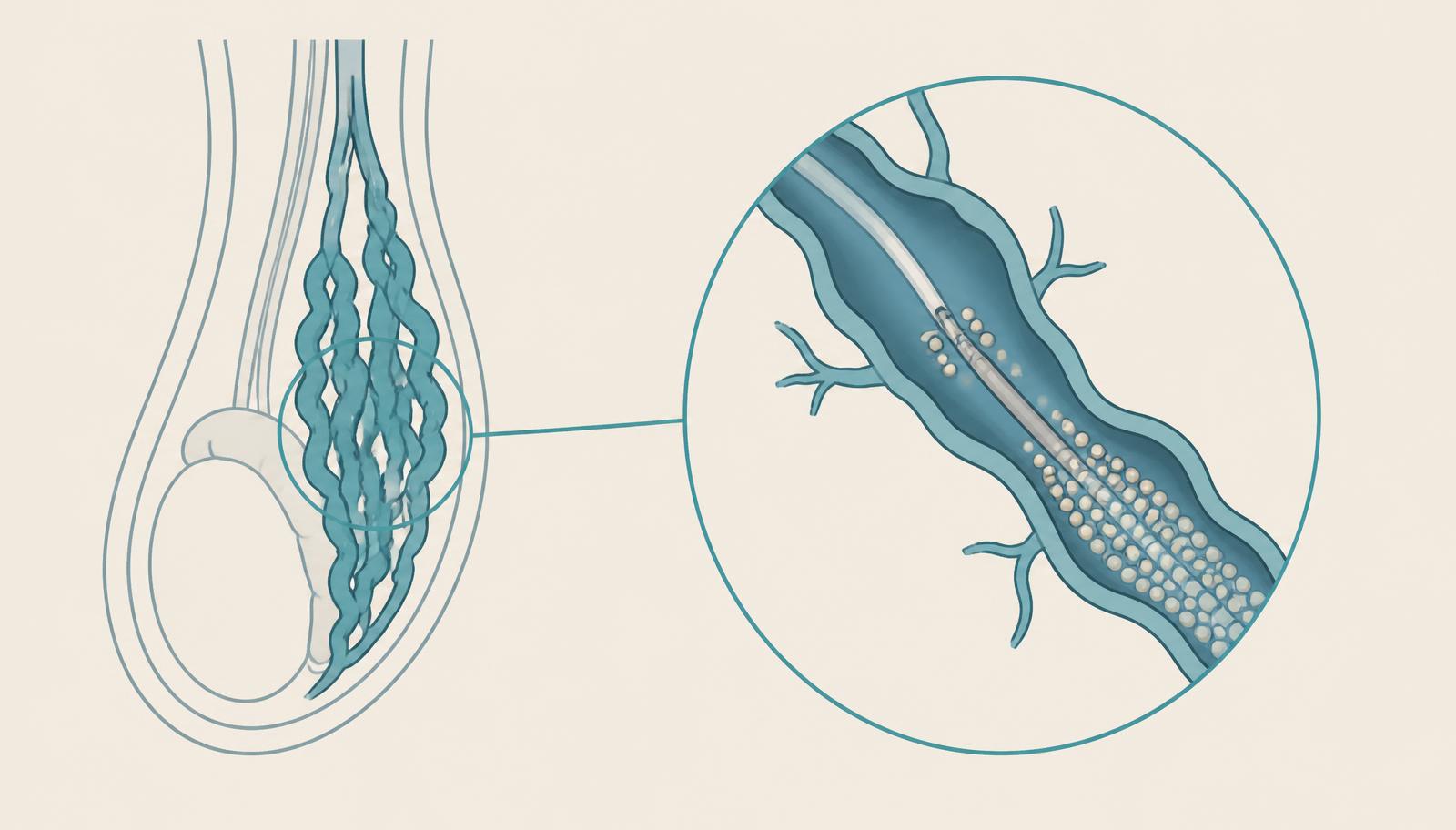
For varicocele there are two main paths: surgery (vein ligation, open, laparoscopic or microsurgical) and percutaneous embolization, performed by the interventional radiologist through a venous puncture. They are not the same thing: here is an honest comparison, based on published scientific literature, of the real advantages and limits of each.
Do you recognise these symptoms?
- A dull ache or sense of heaviness in the testicle, more intense in the evening
- Palpable veins, often described as a "bag of worms"
- Worsening after standing for a long time or after sport
- Sperm analysis abnormalities found during a fertility work-up
Why embolization is less invasive
The most immediate difference is the access route: surgery requires an incision (inguinal, abdominal, or the small cuts of laparoscopy) and stitches to be removed or absorbed. Embolization, instead, is performed through a single venous puncture, under local anaesthesia: no scalpel, no surgical scar, no stitches. You go home the same day and return to daily life considerably faster than after a surgical course.
Why cyanoacrylate glue is superior to other techniques
Not all embolizations are equal: the vein can be occluded with metal coils, sclerosing agents, or cyanoacrylate glue, and the results are not equivalent. Glue occludes the vessel immediately and permanently on contact with blood, while coils and sclerosants act more slowly and can leave room for recanalisation. A study specifically comparing these materials (Favard, Loffroy et al., 2015, Quantitative Imaging in Medicine and Surgery, 182 patients) showed that cyanoacrylate glue has a significantly lower recurrence rate than metal coils/plugs and sclerosing agents (p=0.032), with comparable tolerability for the patient. This is why, in this clinical practice, cyanoacrylate glue is the embolic agent of choice: a review on endovascular treatment of varicocele (Loffroy et al., 2019, La Presse Médicale) now describes embolization with these modern materials as "the first-line therapy" for male genital venous insufficiency.
What the literature on cyanoacrylate embolization shows
Prof. Ezio Lanza is the author of a retrospective study on 185 patients treated with NBCA-MS glue embolization, with a median follow-up of 4.1 years (Lanza et al., 2024, International Urology and Nephrology). The long-term recurrence rate was 12%, with sperm analysis improvement in 81% of evaluable patients — data collected over one of the longest follow-up periods published for this technique. Another study from the same group (Chevallier, Loffroy et al., 2021, Biomedicines, 102 patients) documented a statistically significant improvement in total sperm count, motility and morphology after NBCA glue embolization.
Treatments we can perform
Frequently asked questions
Does embolization leave a scar?
No: the access is a venous puncture of a few millimetres, not a surgical incision. There are no stitches to remove and no visible scars.
Why is cyanoacrylate glue specifically used?
Because it occludes the vessel immediately and stably on contact with blood. A direct comparison with other embolic materials (metal coils, sclerosing agents) shows a significantly lower recurrence rate for glue.
How reliable is it over the long term?
Published data on 185 patients treated with NBCA-MS glue, with a median follow-up of over 4 years, show a 12% recurrence rate.
How soon can I return to normal life?
You go home the same day as the procedure. Since there is no surgical incision to heal, the return to daily activities is generally faster than after a surgical course; for intense sport, a few days' wait is still advisable.
Does it really improve fertility?
Published data on patients treated with cyanoacrylate glue show a significant improvement in total sperm count, motility and morphology after the procedure. The effect on fertility should still be assessed case by case, together with the andrologist.
Scientific sources
- Lanza et al., Int Urol Nephrol 2024 — Long-term efficacy and catheter choice in male varicocele embolization using NBCA-MS glue
- Favard, Loffroy et al., Quant Imaging Med Surg 2015 — Comparison of three different embolic materials for varicocele embolization
- Chevallier, Loffroy et al., Biomedicines 2021 — Relevant biological effects of varicocele embolization with N-butyl cyanoacrylate glue on semen parameters
- Loffroy et al., La Presse Médicale 2019 — Varicoceles, pelvic varices and pelvic congestion syndrome: interventional radiology in diagnosis and treatment
Want to know if it is your case?
At the first consultation we review your clinical history and previous imaging together.
Other guides
The information on this page is for general guidance and does not replace a medical consultation. The indication for treatment must always be assessed individually.